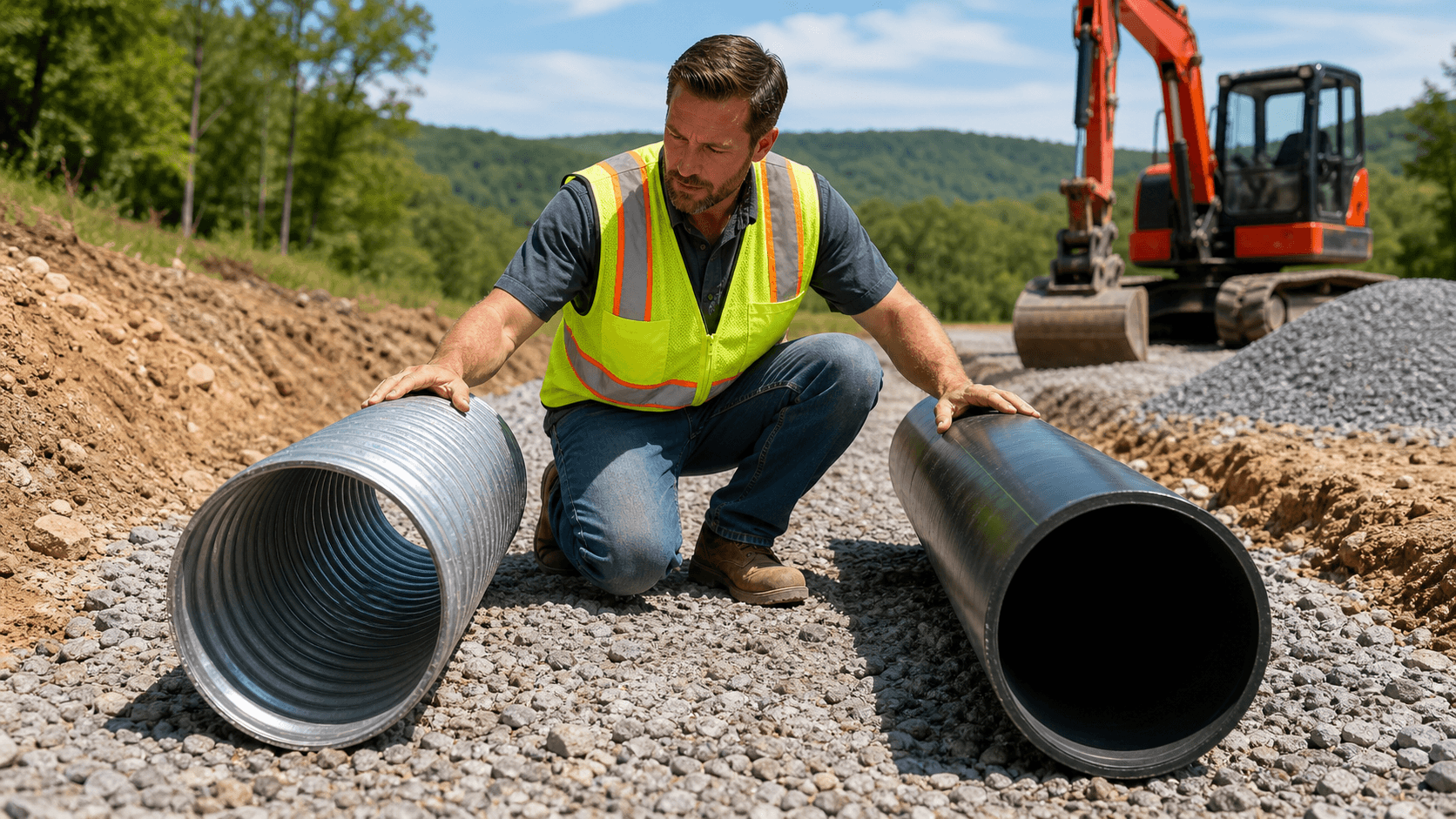
Choose the Right Culvert for a Driveway That Holds Up
A driveway culvert has one job: move water under the drive without letting the roadbed wash out, settle, or become hard to use. In Savannah, Tennessee, and across Southwest Tennessee, Northeast Mississippi, and Northwest Alabama, we see that a pipe is only one part of a working driveway drainage system.
Culverts are not one-size-fits-all. Pipe material matters, but so do water volume, soil type, ditch depth, pipe diameter, cover depth, and the vehicles using the driveway. A pipe that handles passenger cars may not hold up beneath loaded farm trucks, equipment trailers, delivery vehicles, or construction traffic.
At Gravel Express LLC, we handle precision excavation, aggregate placement, drainage work, and driveway construction as a complete job. Our goal is to fit the pipe to your site, not choose a material based only on the lowest price at the start.
Steel Culvert Pipe Handles Heavy Driveway Loads
Corrugated steel pipe has been used for rural driveway crossings for a long time. Its ribbed design adds strength when the pipe has proper cover and compacted aggregate around it. For many farm, residential, and commercial entrances, steel remains a practical option.
Steel can be a good fit when your driveway regularly carries heavy traffic. That may include tractors, loaded trailers, dump trucks, feed trucks, or equipment. The pipe still has to be sized for the ditch and installed at the right depth. A strong pipe placed in a shallow trench with loose gravel over it can still fail.
We may recommend steel when a site has:
- Regular truck, tractor, or equipment traffic
- A need for a larger pipe diameter
- Enough driveway depth above the pipe
- Firm support from properly compacted aggregate
Steel does have one concern: corrosion. Standing water, acidic soil, salt exposure, and abrasive sediment can shorten the service life of untreated or lightly coated steel. Galvanized and coated options can add protection, but we still need to look at the water and soil conditions before choosing the pipe.
Before rebuilding the driveway surface, we check ditch flow, excavation depth, pipe slope, aggregate bedding, and compaction. Those details determine whether the crossing stays firm after traffic starts using it.
HDPE Pipe Resists Corrosion in Wet Ground
HDPE, short for high-density polyethylene, is a durable plastic pipe often used for driveway drainage. Most driveway applications use corrugated HDPE with ribs on the outside and a smoother interior wall. The outside ribs provide support, while the smoother interior helps water move through the pipe with less resistance.
Its main advantage is corrosion resistance. HDPE does not rust, which can make it a strong choice where ditches stay wet, water stands for long periods, or soil conditions are hard on metal pipe. Runoff carrying fertilizer, organic material, or other corrosive elements can also affect the decision.
That does not mean HDPE can be dropped into a ditch without careful preparation. It needs stable bedding and compacted backfill along both sides to support the weight above it. Poor backfill can allow the pipe to move, deform, or leave the driveway surface unsupported.
During culvert pipe installation, we determine whether HDPE has the support, cover depth, and pipe size needed for the driveway's expected traffic. The material is selected based on the ground and load conditions, not a generic recommendation.
Water, Soil, and Traffic Decide the Material
Water flow comes first. A culvert must be large enough to carry normal runoff and heavier stormwater without backing water up in the ditch, washing across the driveway, or flooding nearby ground. An undersized pipe can create major problems because water will find another way around the drive.
Ground conditions also matter. Soft soil, deep ditches, steep slopes, loose fill, and poor drainage can require more excavation, a stronger aggregate base, a larger pipe, headwalls, or erosion control at the outlet. The pipe needs to follow the natural drainage path with enough slope to keep water and sediment from sitting inside it.
Driveway traffic should be considered honestly. A light residential driveway has different needs than a working farm entrance, new home construction access, or commercial drive. We plan for the heaviest routine load, not just the vehicle that uses the driveway most often.
Proper Installation Protects the Pipe and Driveway
Proper culvert pipe installation includes grading the approach, placing the pipe at the correct elevation, compacting aggregate around it, and building enough driveway depth above it. These steps protect the pipe and help prevent potholes, rutting, washouts, and edge failure.
Our work starts by evaluating the ditch and marking the pipe location. We excavate to the required depth, prepare a stable bedding area, set the pipe to the proper slope, and confirm that water can enter and exit without obstruction.
Aggregate placement is a major part of the job. Clean, well-placed gravel around the bottom and sides of the pipe supports it and helps spread vehicle weight. Backfill should go in controlled layers and be compacted properly. Simply pushing dirt over a pipe can leave voids that later turn into soft spots or sinkholes.
A completed driveway also needs to shed water. We shape the surface with a crown or cross slope so water moves away instead of sitting over the culvert. Ditch lines may need reshaping to direct runoff into the pipe rather than around the driveway. Faster water may need erosion protection near the outlet.
Make the Culvert Decision Based on the Site
Steel may be the right choice for a high-load driveway with proper cover and suitable site conditions. HDPE may be the better option where corrosion resistance and wet-ground performance matter most. Neither material can make up for poor sizing, weak bedding, shallow cover, or inadequate compaction.
The right culvert is the one that matches your driveway, ditch, soil, water flow, and expected traffic. When those parts work together, the pipe is protected, the driveway stays more stable, and water has a clear path where it needs to go.
Get the Right Drainage Work for Your Driveway
Gravel Express provides culvert pipe installation with proper grading, placement, and backfill to support your driveway and manage runoff. Our team can assess the conditions on your property and recommend a practical material and installation approach. For a free estimate, contact us or call 731-607-9558.
Call 731-607-9558 for a free estimate.