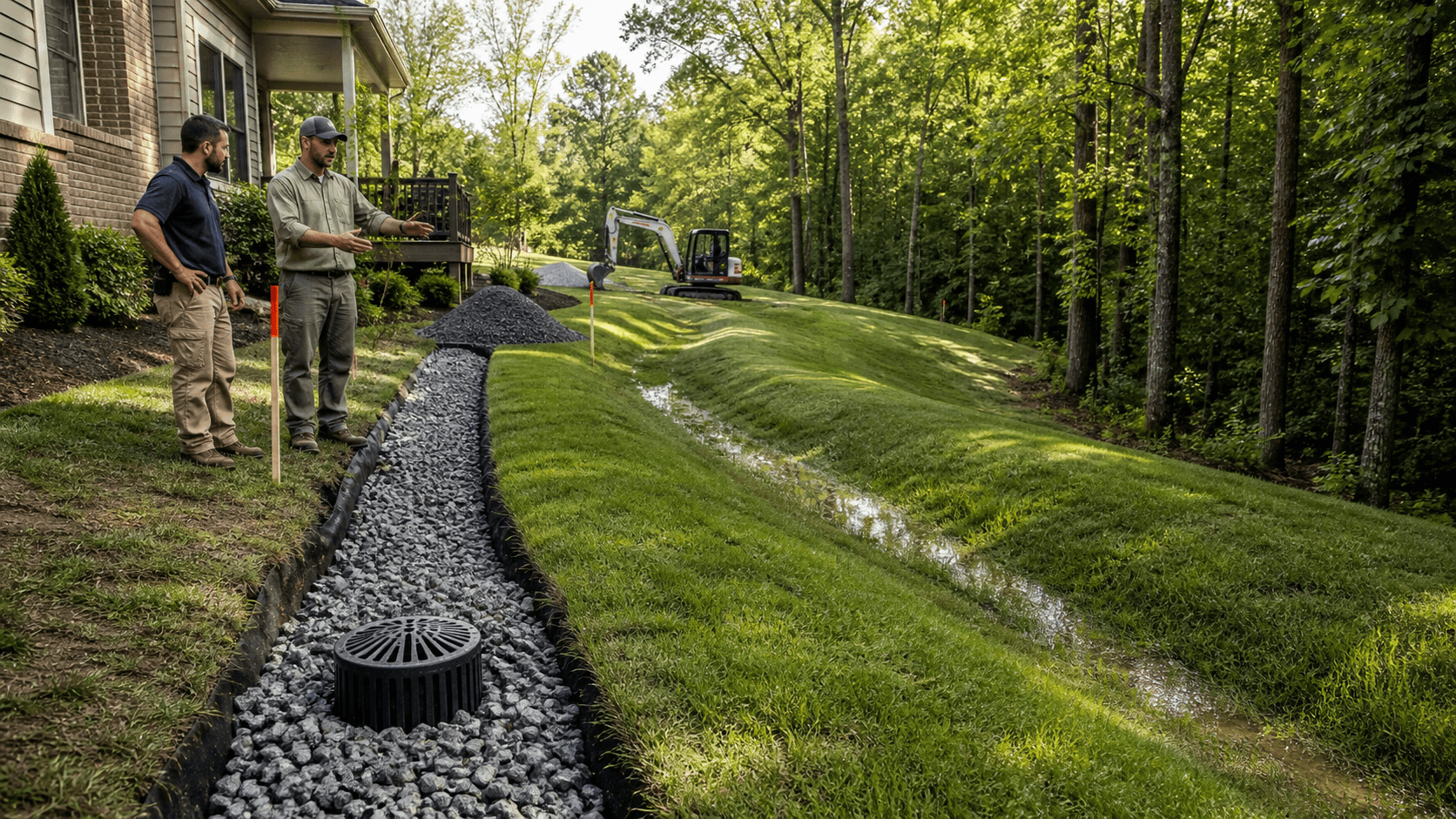
Standing water can damage a driveway, soften a building area, and push runoff toward places it does not belong. Around Savannah, Tennessee, we often see wet tire ruts, washed gravel, muddy entrances, and low spots that stay soft long after rain ends. October is a practical time to inspect drainage paths before late fall and winter rain saturates the ground.
French drains and swales both move water, but they do different jobs. The right option depends on where the water starts, how it travels, and where it can safely discharge.
Stop Water Before It Damages Your Savannah Property
Drainage trouble usually gives you warning signs before it becomes a larger repair. Water pooling beside a home, shop, or barn should not be ignored. Neither should runoff that crosses a driveway, cuts into its edges, or heads toward a foundation.
Common signs we look for include:
- Water standing near a foundation or crawl space
- Tire ruts and access lanes that remain wet
- Gravel washing off driveway edges or into ditches
- Soggy pasture gates and field entrances
- Runoff coming downhill toward buildings or pads
Clay soils, rolling ground, wooded lots, gravel drives, and low-lying areas can all hold or redirect water in ways that create problems. We see these conditions within the 50-mile tri-state radius of Savannah, Tennessee, across Hardin County, McNairy County, Wayne County, Alcorn County, Tishomingo County, and Lauderdale County.
Before recommending drainage work, we determine whether the problem is surface runoff, underground seepage, roof water, driveway runoff, or water coming off a cleared slope. That distinction matters because a French drain installation is not a replacement for proper surface grading, and a swale will not always solve water collecting below ground.
When French Drain Installation Solves Underground Water Problems
French drain installation is typically used when water needs to be collected below the surface and redirected away from a problem area. This may include a wet section beside a structure, a saturated driveway base, or runoff collecting behind a retaining area.
A French drain is built in a properly excavated trench. We line the trench as needed, place drainage gravel, install perforated pipe, and direct the system to a safe outlet. Water moves through the gravel, enters the pipe, and follows the grade away from the wet area.
This approach is often a good fit for:
- Wet ground near foundations and crawl spaces
- Water seeping toward barns, shops, and equipment buildings
- Saturated areas beside driveway edges
- Runoff collecting behind retaining sections
- Persistent wet spots where surface grading alone will not work
Pipe depth, trench slope, soil conditions, outlet location, and septic separation all need to be considered before work begins. A drain with no workable outlet can hold water instead of moving it away. We evaluate the grade before recommending French drain installation in Savannah and nearby properties.
When a Swale Is the Better Choice for Surface Runoff
A swale is a shallow, graded channel that guides water across the surface. It is often the practical choice when runoff is coming from a hill, field, road, roof line, or large open yard.
Rather than burying pipe across an entire property, we can shape the ground to direct water around a home pad, equipment building, driveway, pasture gate, or cleared construction site. On the right property, a swale gives water a defined path without letting it spread across traffic areas or collect near structures.
Grade controls whether a swale works. If it is too flat, water stands in the channel. If it is too steep, runoff can cut into the soil and cause erosion. Precision excavation gives the swale a steady fall while protecting the surrounding ground.
Appearance and upkeep also matter. We can build swales to be grassed in, and higher-flow sections may need rock protection. Keeping the channel clear of brush, leaves, loose gravel, and fill dirt helps water continue moving as intended.
Compare Site Limits and Long-Term Maintenance
The lowest-material approach is not always the right drainage choice. A system has to fit the layout of your property, the amount of water involved, the soil type, and how you need to access the area.
French drains require trench excavation, pipe, drainage gravel, and a planned outlet. Swales often use fewer installed materials, but they need open space and careful grading. Length, depth, rock needs, discharge conditions, and access all affect the scope of the work.
Maintenance looks different for each system. French drains need protected outlets and occasional checks for blocked pipe or damaged discharge areas. Swales need mowing, reshaping when needed, and erosion control. Both work better when gutters, driveway culverts, and nearby grades are kept in working order.
Some properties need both systems. A swale can intercept runoff coming down an uphill slope, while a French drain handles water collecting near a foundation or driveway base. We often consider this combined approach on sloped lots around Adamsville, Selmer, Counce, Corinth, Iuka, and Florence.
Plan Drainage with Driveways, Clearing, and Site Work
Drainage should be part of the plan before a driveway is built, land is cleared, or a building pad is finished. Correcting water problems after gravel has washed away or a pad stays wet is usually more disruptive.
A gravel driveway needs the right crown, stable base material, side drainage, and culverts where water crosses the drive. Water moving over or through the driveway can create potholes, washboarding, soft spots, and lost gravel.
Land clearing and excavation can also change where runoff travels. Removing trees, brush, or topsoil may expose slopes and send water toward a new building site, field lane, or access road. We consider drainage paths when preparing cleared areas, pads, culvert locations, and driveways.
After a steady fall rain, walk the property and note where water begins to collect, where it crosses traffic areas, and where it stops. Pay close attention to runoff near homes, shops, roads, field entrances, and planned construction.
Get a Drainage Plan Before Winter Rains Arrive
A proper drainage plan starts with the water path, not with a single product or trench. When water is mostly moving across the ground, a swale may be the better answer. When it is collecting below the surface near a structure or driveway base, French drain installation may make more sense.
Before winter rain exposes the weak points in your property, identify where water is collecting and what it threatens. A clear look at grade, soil, outlets, driveways, and nearby structures helps prevent a temporary wet spot from becoming a larger access or foundation problem.
Use this checklist when inspecting drainage around your property:
- Watch where water enters and leaves the property during rain
- Check foundations, crawl spaces, barns, shops, and building pads for standing water
- Look for washed gravel, ruts, potholes, and soft spots along driveways and access lanes
- Confirm culverts, ditches, gutters, and drain outlets are clear
- Identify slopes that direct runoff toward structures or traffic areas
- Note whether water is moving across the surface or seeping up from below ground
- Check that any discharge area directs water away from buildings, septic systems, and neighboring property
Documenting these conditions after a rain makes it easier to identify whether grading, a swale, a French drain, culvert work, or a combined drainage approach is needed. Addressing the water path before winter saturation protects driveways, building areas, and working ground throughout the season.
Protect Your Property With the Right Drainage Plan
Gravel Express provides french drain installation and precision excavation for wet Savannah properties. Our team evaluates runoff, soil conditions, and the areas that need to stay usable. Call 731-607-9558 or contact us to request a free estimate.